
Power BI · Tableau · Metabase
Power BI, Tableau and Metabase reporting that matches your source data and business rules.
Vizmask builds new reports and fixes existing ones inside the platform you already pay for. We agree what each figure means before anything is built, check the data behind it, reconcile the result against your source, then set up the refresh and hand over short notes your team can maintain.
There is no public price list. We look at the job first and send a written quote with a date.
When it helps
The usual reasons someone gets in touch
Most of our work starts with a report that already exists and that somebody has stopped trusting, or with one that should exist and doesn't. A few situations come up again and again:
Two reports show different revenue for the same month, and nobody can say which one is right.
A dashboard that worked for years broke after a move to a new ERP, CRM or data warehouse.
Month-end still depends on a spreadsheet that one person maintains and everyone else is afraid to touch.
Management has asked for a view that doesn't exist, and the internal team's queue is already months long.
Someone built a quick prototype in Excel, an AI tool or a generated web page, and it now has to become a report people rely on every week.
A Power BI or Tableau estate has grown into dozens of overlapping files, and nobody is sure which ones still matter.
If one of those sounds familiar, the first conversation is usually short. We ask what the report is for, who reads it, and where the numbers come from.
Examples
Reporting examples
The examples below show the standard of the work. Where a caption names a fictional company, the data behind it is synthetic.
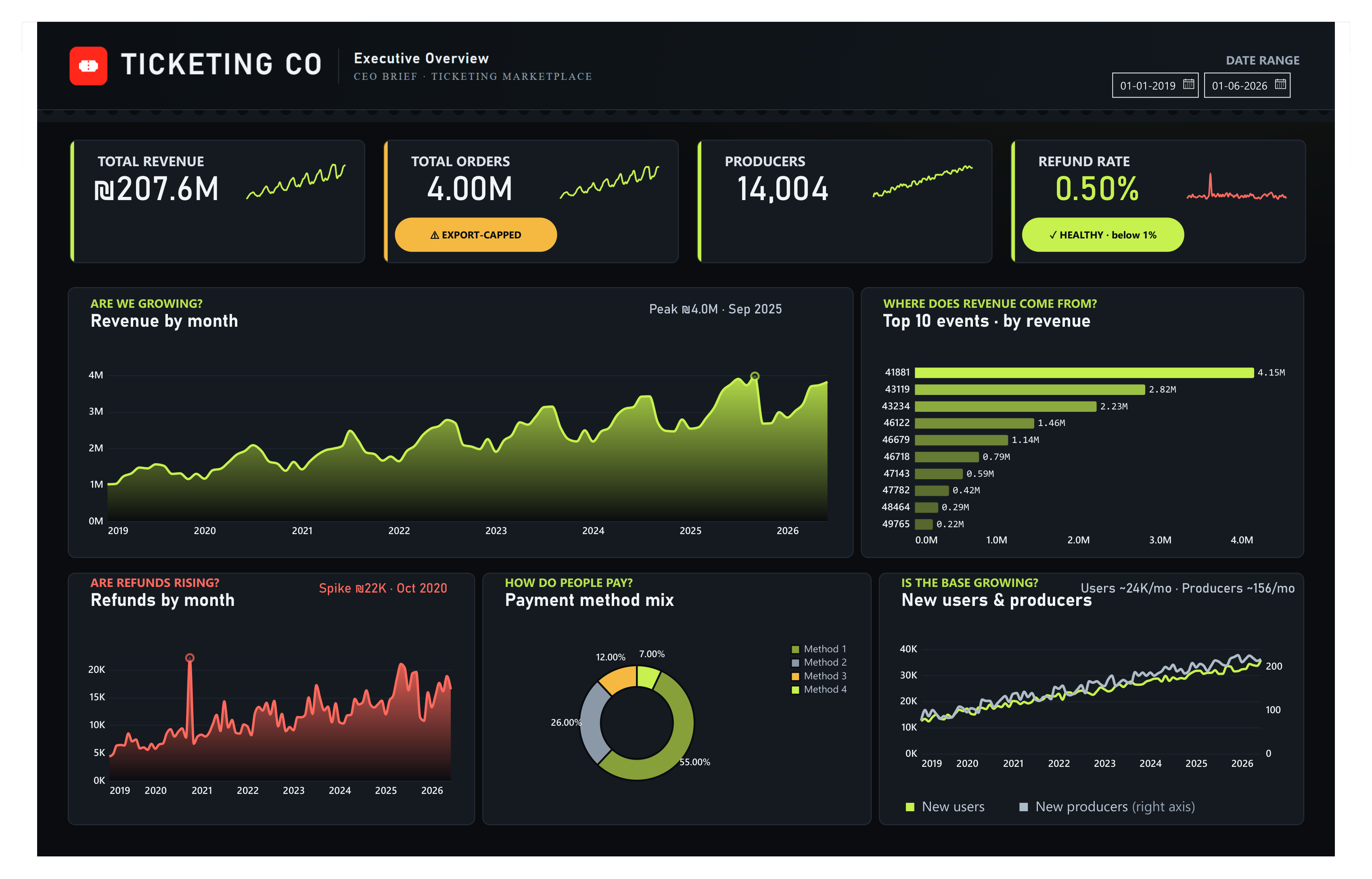
Power BI dashboard example. Live proof
Power BI: Live dashboard: hover any point for exact values. Power BI: Change the date range and the KPIs + charts recompute live. 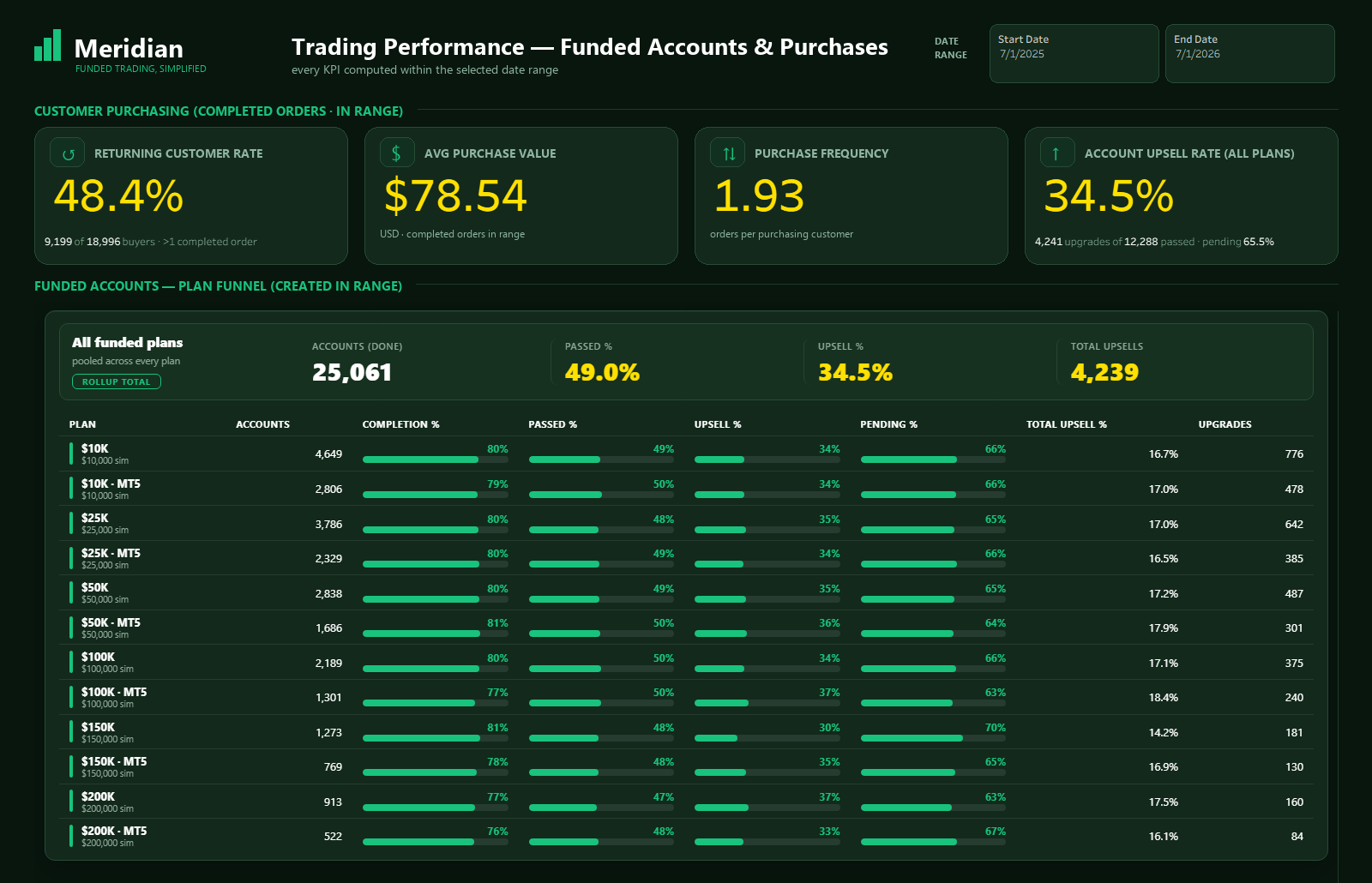
A real, interactive Tableau dashboard, built on synthetic sample data. Live proof
Tableau: Click a column header and the table re-sorts live. 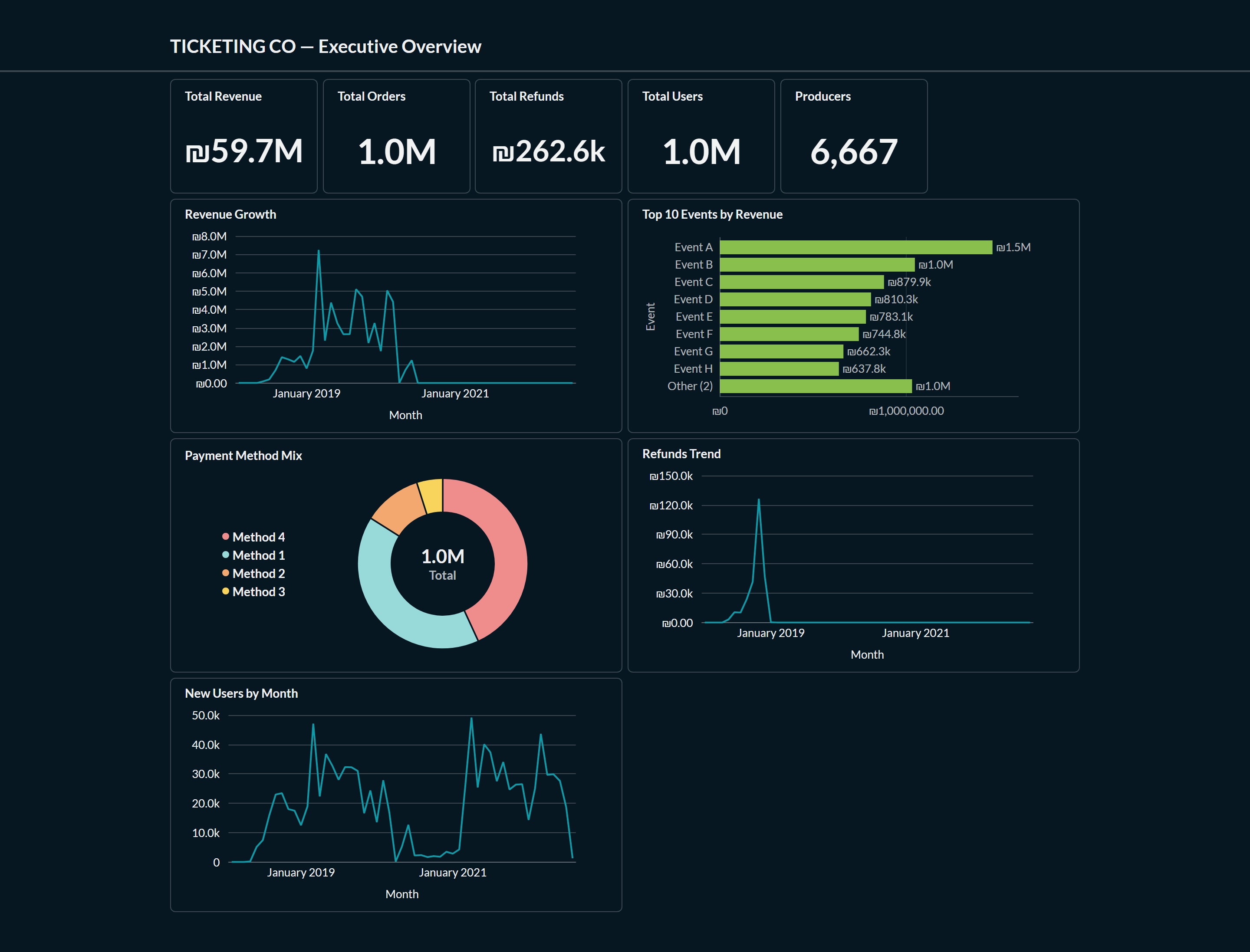
A dashboard we built, on synthetic sample data. 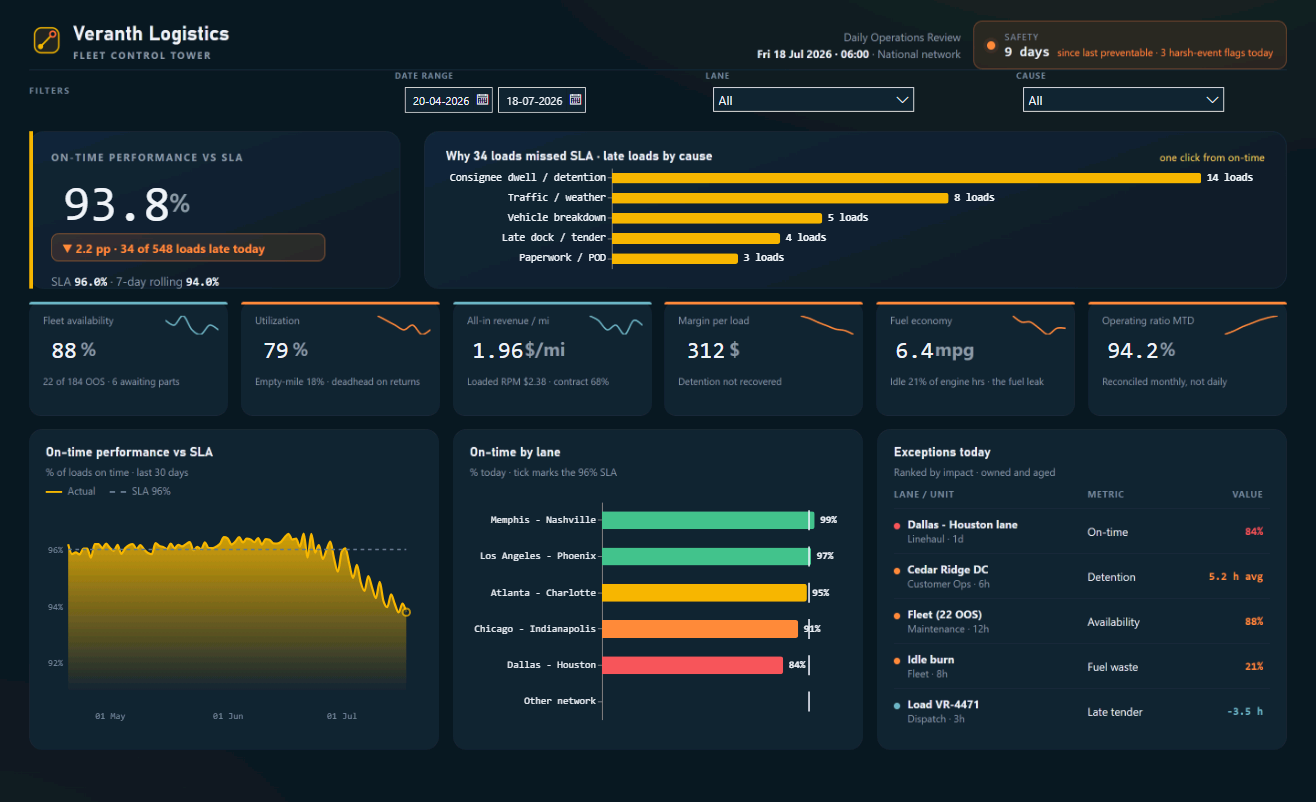
A real, interactive Power BI dashboard for a fictional freight company, Veranth Logistics, built on 100% synthetic data. Live proof
Power BI: Filter by lane and the page reacts live: on-time performance moves from 93.8% to 84.0%. 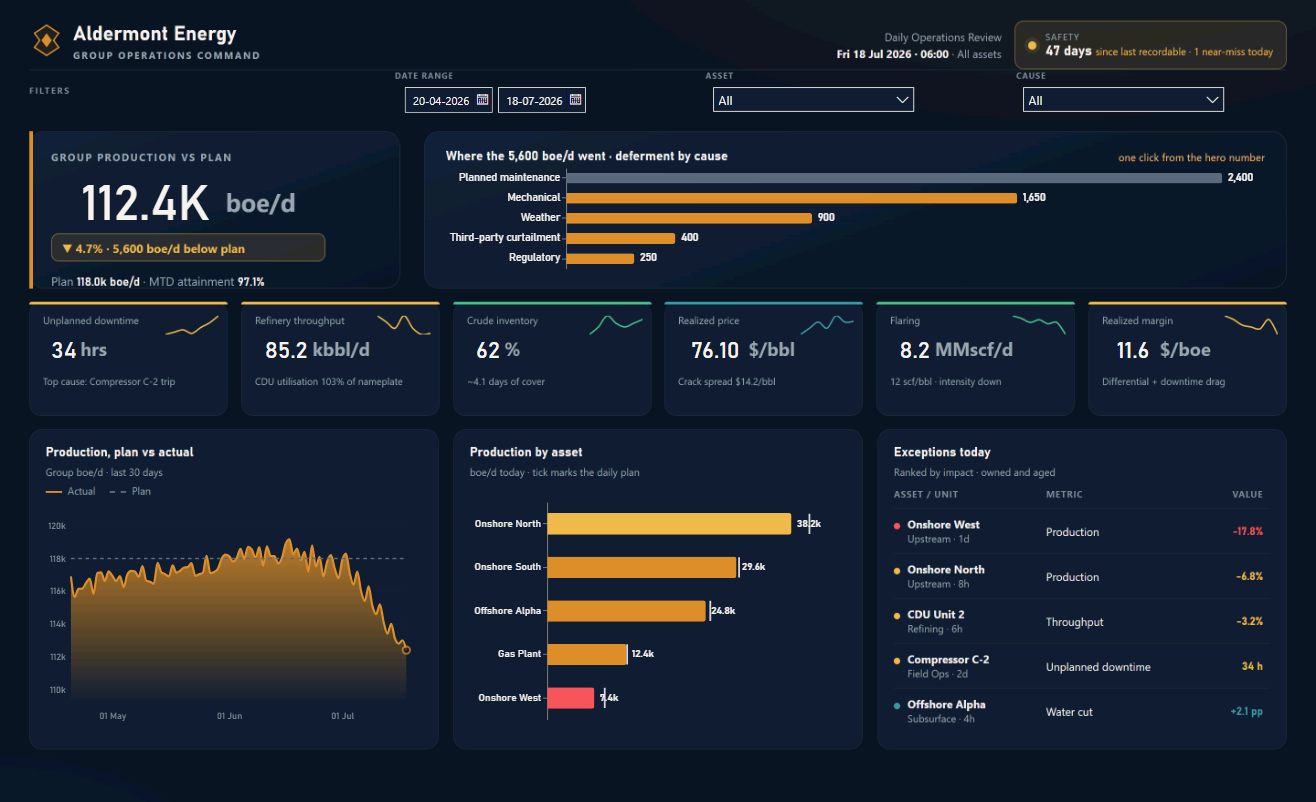
A real, interactive Power BI dashboard for a fictional petroleum company, Aldermont Energy, built on 100% synthetic data. Live proof
Power BI: Pick an asset and the whole page cross-filters live: the headline moves from 112.4K to 38.2K and the trend axis rescales. 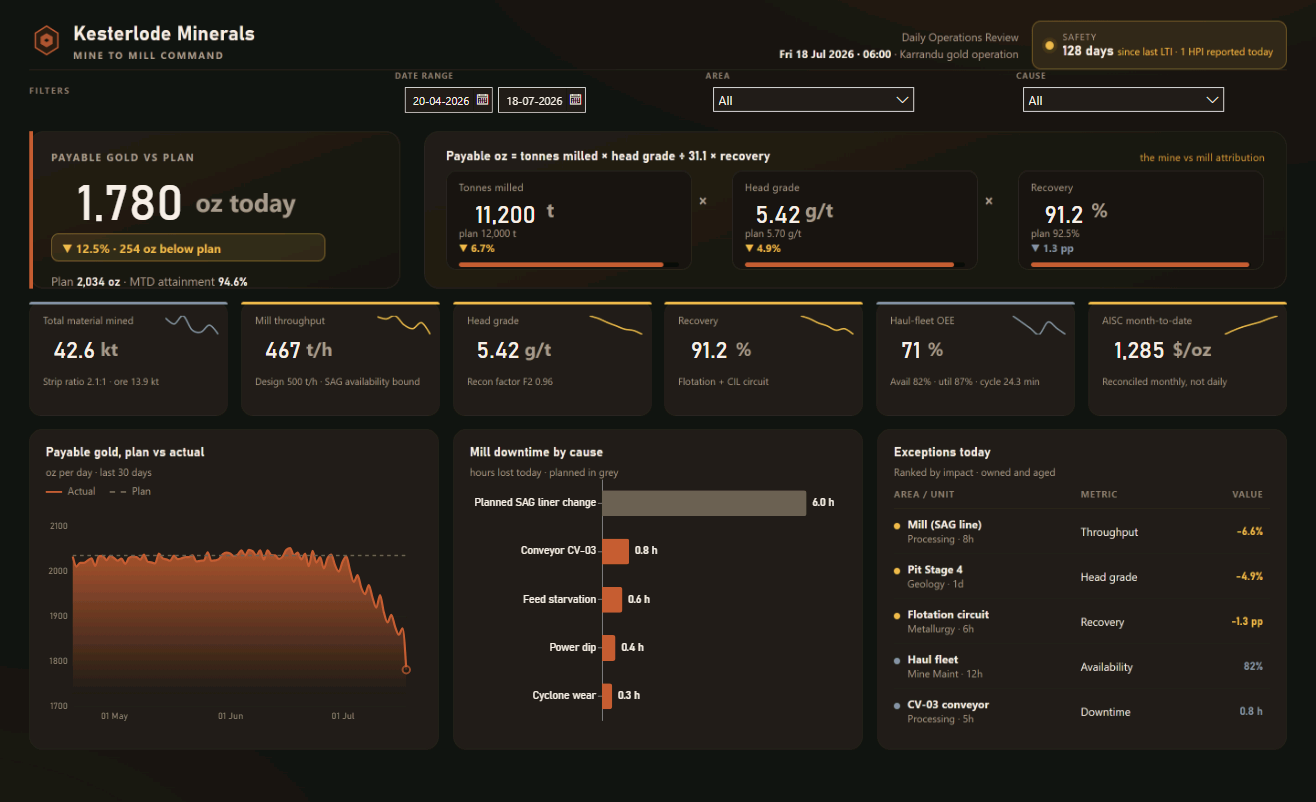
A real, interactive Power BI dashboard for a fictional mining company, Kesterlode Minerals, built on 100% synthetic data. Live proof
Power BI: Open the area slicer to explore sites, and hover the trend for live figures on demand.
Built once, relied on every week
Producing a dashboard once is the easy part
A first version of a chart or a calculation can come together in an afternoon, whether a person, a template or an AI tool put it together, and we use AI tools in our own work too. None of them knows that your finance team excludes intercompany sales, or that the warehouse stopped recording returns properly in March.
Business reporting has to survive the months after that. The definitions have to be agreed and written down, the figures checked against the source, and the report kept right when something upstream changes, with somebody accountable when a number looks wrong. That is the part a client hires us for.
What a job includes
What you get, and in what order
We start by writing down what each measure means: which transactions count as revenue, which date a booking belongs to, which filters every page applies. Then we look at the source data itself, because that is where most reporting problems begin. Duplicate customers, a status field nobody maintains and a currency that changed halfway through the year all look fine on a chart.
The report is built in your own Power BI, Tableau or Metabase environment. Headline figures are reconciled against the source system wherever the source allows it, and where it doesn't, we say so and agree with you how the report should handle the gap. We also review how it performs, so a slow page gets fixed before handover rather than after your first board meeting.
Where it is part of the job, we set up who can see what and schedule the refresh, using what your platform and licence already include. At the end you get a short written handover: what the important numbers mean, where they come from and what to check if one looks wrong. For 14 calendar days after delivery, fixing defects against what we agreed to build is part of the job. New requirements, new metrics, changes to your source systems and new functionality are quoted separately, so you always know what you are paying for.
Honestly
When you probably don't need us
If you need a quick look at a single spreadsheet, Excel or an AI chat tool will often get you there faster than any outside help. A prototype that only has to survive one meeting can be a generated web page. If your internal BI team has the time, they know your data better than we do on day one, and they should do the work. A good freelancer you already trust, who documents what they build, may be all a clean one-off job needs. We would rather tell you that now than sell you a project you don't need.
Accountability
What we answer for, and what we don't
Within the scope we agree in writing, we answer for three things: the figures match the agreed source at handover, the definitions are written down and agreed with you, and defects in our work are fixed during the 14 days after delivery. We don't answer for the quality of the data your systems produce, for platform outages or licence limits, or for decisions made on the numbers. When a source is incomplete or contradicts itself, we show you where, and the report handles it the way you decide.
Engagements
Start with one problem
A first job is usually one report that needs fixing, or one that doesn't exist yet. We talk it through on a short call and look at a sample of the data if you can share one. You then get a written scope: the deliverable, the date and a fixed quote for that job, built in the tool you already use. If you go ahead, we build it, check it against your source and hand it over. Help after that is available if it turns out to be useful, and nothing commits you to it.
Want to know what yours would cost?
Describe the job and we will come back with a scope and a number.
Who does the work
Who you would be working with

Vizmask is a BI delivery practice led by Sadat Mohammed Khan, who personally oversees every engagement.
Sadat's background: 10 years in BI and analytics, with 150+ projects delivered independently for clients across multiple industries.
Data handling
If your data is sensitive
You don't have to send sensitive data as it is. Our in-browser tool replaces names, values and identifiers with consistent stand-ins before anything leaves your machine, and the key to reverse them stays with you. This is pseudonymisation, not anonymisation: column names leave in the default mode, and strong patterns in the data can survive. For stricter cases we can work from structure and summary statistics only, or build without any third-party AI at all. A data processing agreement is in place before we handle any client data.
Standard
Sanitised in your browser before anything is shared
Hybrid
De-identified structure and statistics only
Offline
No third-party AI, on request
FAQ
Do you use AI?
Yes, in our own work, as most BI teams now do. It speeds up parts of the build. It doesn't decide what your numbers mean or check them against your source; that part is ours.
Can I pay for a single dashboard?
Yes. Most first jobs are one report or one fix, scoped and quoted on their own.
What if a number is wrong after delivery?
Tell us. For 14 calendar days after delivery, we fix defects against what we agreed to build as part of the job. If the source data has changed, or a definition or requirement needs to change, we scope that with you first.
Do you work alongside an internal BI team?
Yes. Often your team keeps the platform and we take one report or one fix off their queue, with notes they can maintain afterwards.
Which tools do you work in?
Power BI, Tableau and Metabase, in your own environment and on your own licences. If your reporting runs on something else, ask; we will tell you plainly if it is outside what we do well.
Who owns the work?
You do. Ownership of what we build is assigned to you in the contract.
Is my data anonymous?
No, and we won't claim it is. Our in-browser tool pseudonymises it, which makes it materially harder to re-identify. Column names leave in the default mode, and dominant patterns can persist.
Where are you based?
Hyderabad, India. Calls are scheduled to suit your time zone.
Do you sign NDAs?
Yes. For regulated data we can work from structure only, or build without any third-party AI.
Tell us about the reporting problem
A few lines is enough: what the report is for, which tool it lives in, and what is wrong with it or missing. We reply with questions or a short scope.